
Leobit Research Maps Voice AI Engine Strengths for Business Deployment Decisions
Leobit evaluated GPT Live, Gemini 3.8 Live, ElevenLabs Agents, and Azure GPT Realtime, revealing differences in
Press Release Disclaimer: This is a press release distributed through the XPR Media network. It has not been independently verified by our newsroom.
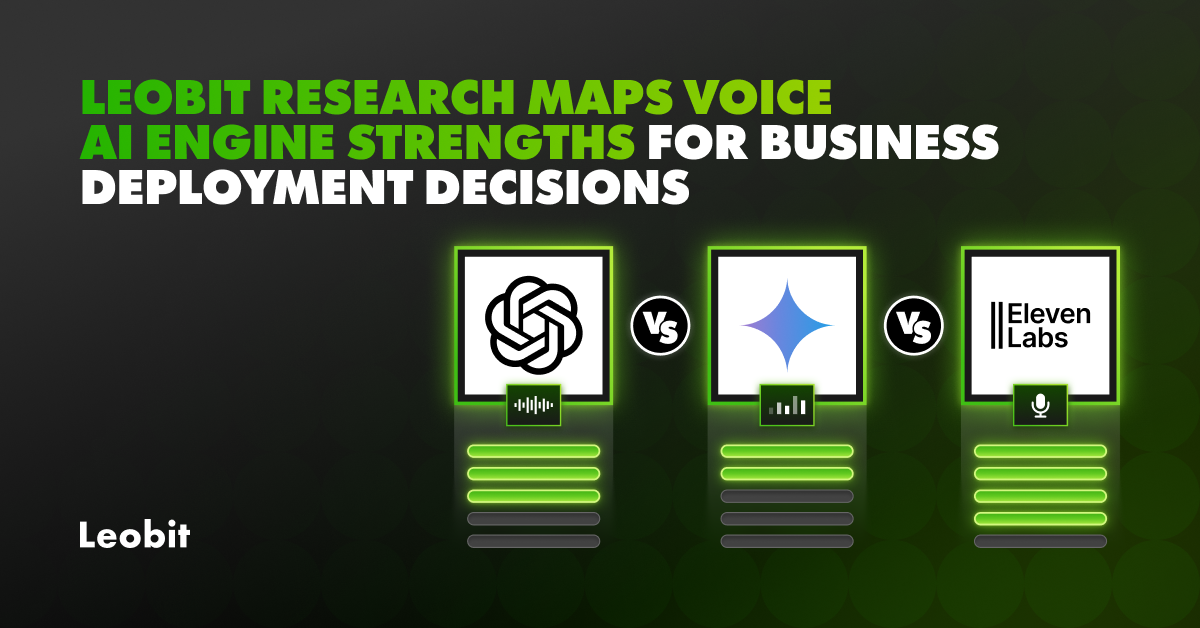

Leobit evaluated GPT Live, Gemini 3.8 Live, ElevenLabs Agents, and Azure GPT Realtime, revealing differences in response speed, accuracy, performance, and cost.
AUSTIN, TX, UNITED STATES, November 19, 2026 /EINPresswire.com/ — Leobit, a .NET, AI, and web application development company, has published the results of a benchmark study comparing four real-time voice AI engines: OpenAI’s GPT Live, Google’s Gemini 3.8 Live, ElevenLabs Agents, and Azure GPT Realtime. The research evaluated response speed, answer accuracy, multilingual capabilities, performance under challenging audio conditions, and cost per conversation. The findings revealed distinct strengths across the four engines, with no single solution outperforming the others in every category.
The study comes amid rapid advancements in real-time voice AI technology. GPT Live became available through the API on September 10, 2026, followed by Gemini 3.8 Live on September 15 and ElevenLabs v4 speech models on September 28. Leobit initiated the research while selecting an engine for an internal voice assistant that retrieves answers from a company knowledge base and responds out loud, an approach known as retrieval-augmented generation (RAG). The same decision now faces any business adopting voice AI: the engines are only weeks old, and vendor demonstrations do not show how they handle real questions, multiple languages, or imperfect audio.
How the Study Was Conducted
To ensure a consistent comparison, Leobit tested all four engines using identical instructions, data-retrieval functions, and prerecorded audio across 11 scripted scenarios. Additional tests assessed multilingual performance in German, Spanish, and French, as well as the engines’ ability to handle seven types of challenging audio conditions, including background noise and overlapping speech.
Key Findings
The results highlighted notable differences in response speed and cost efficiency.
– Gemini 3.8 Live delivered the fastest substantive responses when knowledge-base retrieval was required, with a median of 1.43 seconds, and showed the lowest estimated cost, from $0.04 to $0.09 for a typical three-minute conversation at published pricing. This combination makes it a strong candidate for high-volume assistants, where cost per conversation determines feasibility.
– GPT Live achieved the fastest initial audible response, with a median of 0.79 seconds, and the highest speech recognition accuracy in the study. Because the engine begins with a brief introductory phrase while retrieving information, its substantive answer arrived in approximately 3.6 seconds, a distinction that matters when engines are compared on latency figures alone.
-Under challenging audio conditions, GPT Live and Gemini 3.8 Live delivered fully correct responses in 83 and 80 out of 84 test runs, respectively, compared with 55 for ElevenLabs Agents and 48 for Azure GPT Realtime. These results indicate how the engines are likely to perform in phone and call-center settings, where audio is rarely clean.
-Accurate speech recognition did not always translate into accurate responses. Azure GPT Realtime maintained strong transcription accuracy under noisy conditions, yet some runs revealed inconsistencies in language selection and knowledge-base retrieval. In one French-language scenario, the engine generated inaccurate content without retrieving the required information. The finding suggests judging a voice assistant by its final answers, in every supported language, rather than by transcription metrics.
Key Takeaways for Businesses
The study’s broader conclusion is that the right engine depends on the intended use case, whether the priority is speed, reliable knowledge retrieval, multilingual interactions, or cost efficiency. Published specifications did not predict the differences the tests revealed, so the study recommends evaluating candidate engines on a company’s own scenarios before deployment.
The complete real-time voice AI benchmark is available on the Leobit blog.
About Leobit
Leobit is a .NET, AI, and web application development company for technology companies and startups in the US, the EU, and beyond. Our technology focus covers .NET, Blazor, .NET MAUI, ASP.NET, Angular, iOS, Android, Azure, Ruby, PHP, React, and a comprehensive range of other technologies from Microsoft, web, and mobile stacks. Leobit has a representative office in Austin, TX (USA) and development centers in Lviv (Ukraine), Tallinn (Estonia), London (UK), and Krakow (Poland).
Iryna Troshchynska
Leobit
+1 512-399-5386
marketing@leobit.com
Legal Disclaimer:
EIN Presswire provides this news content “as is” without warranty of any kind. We do not accept any responsibility or liability
for the accuracy, content, images, videos, licenses, completeness, legality, or reliability of the information contained in this
article. If you have any complaints or copyright issues related to this article, kindly contact the author above.

Media gallery
