
Multiphysics optimization framework for high-power fiber amplifiers
SHANNON, IRELAND, September 23, 2026 /EINPresswire.com/ -- Announcing a new publication from Opto-Electronic Sciences;
Press Release Disclaimer: This is a press release distributed through the XPR Media network. It has not been independently verified by our newsroom.

SHANNON, IRELAND, September 23, 2026 /EINPresswire.com/ — Announcing a new publication from Opto-Electronic Sciences; DOI 10.29026/oes.2026.260029.
A new multiphysics optimization framework developed by Professor Jinbao Chen and colleagues at the National University of Defense Technology is opening new possibilities for the intelligent design of high-power fiber lasers.
High-power fiber lasers have emerged as the superior light sources for advanced manufacturing and high-energy laser systems, owing to their exceptional merits such as all-electric drive, high conversion efficiency, superior beam quality, and flexible delivery. Over the past two decades, high-beam-quality fiber lasers have made remarkable advances in power scaling and supply-chain localization. However, further power scaling is inherently bottlenecked by two fundamental challenges. First, output-power growth is severely limited by nonlinearities such as stimulated Brillouin scattering (SBS) and stimulated Raman scattering (SRS), while beam quality degrades due to transverse mode instability (TMI); moreover, these detrimental factors become increasingly coupled and mutually constraining as power increases. Second, this dual constraint of nonlinear and thermal effects demands more meticulous tailoring of core components, including gain fibers, pump sources, and delivery assemblies. Unfortunately, traditional optimization frameworks remain bound to single-parameter, single-effect, and linearly iterative approaches, leaving them fundamentally incapable of achieving global multiphysics optimization across such a complex parameter space.
Scientific machine learning (SciML) offers a promising technical pathway to build an intelligent, multi-parameter optimization framework for high-power fiber lasers by combining data-driven efficiency with physical mechanistic rigor, driving a paradigm shift from localized tuning to global co-design. Nevertheless, translating this potential into reality hinges on overcoming three critical bottlenecks: establishing the co-design architecture, developing high-fidelity coupled physical models, and formulating physics-interpretable optimization strategies.
Co-design Architecture: From traditional heuristic linear iteration to predictive global optimization
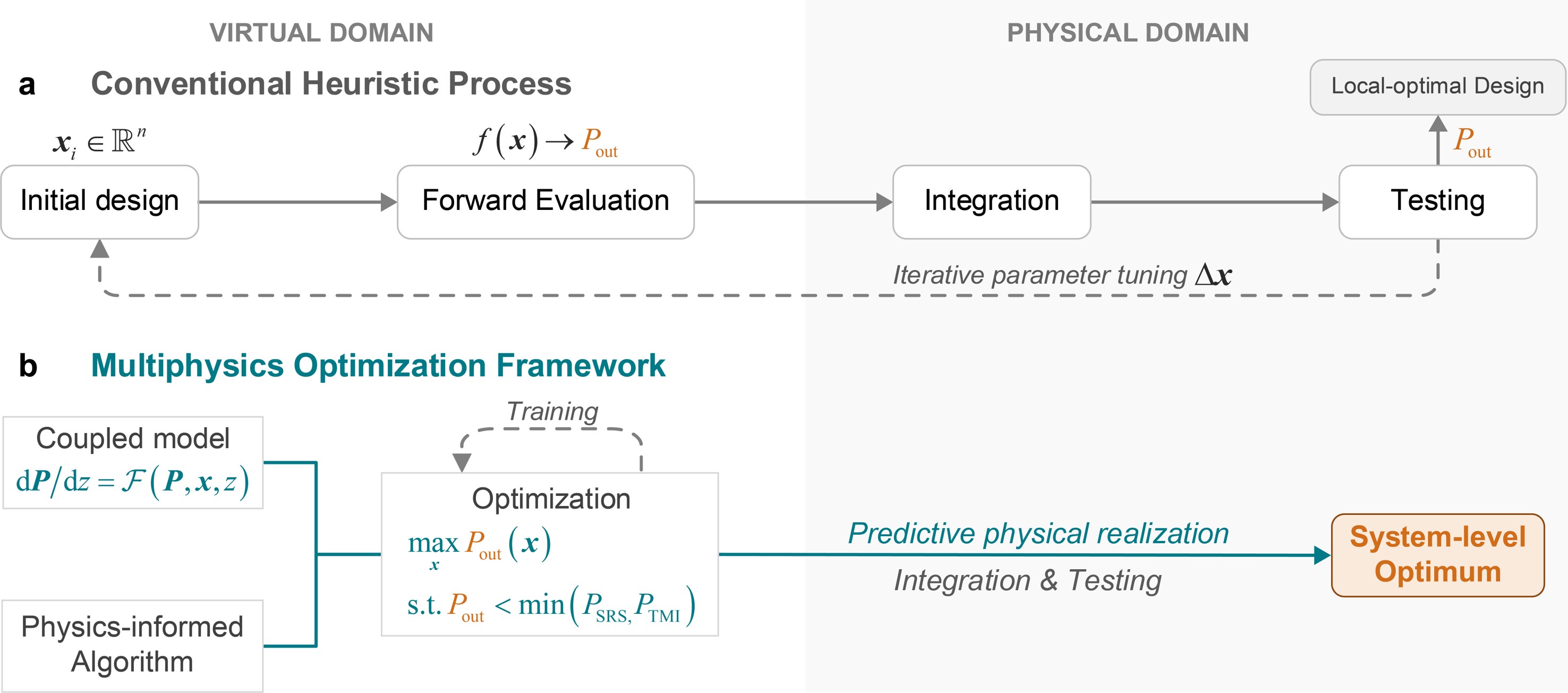
Traditional heuristic methods often rely on sequential linear iterations, where forward evaluations based on empirical models or parametric sweeps are routinely followed by physical testing. Because system design and optimization depend heavily on such iterative feedback loops between simulation and physical setups, these approaches struggle to capture the complex, high-dimensional mappings between design parameters and system performance. Consequently, they suffer from prolonged component development cycles, massive resource consumption, and a high susceptibility to local optima. To overcome these limitations, this paper proposes a multiphysics optimization framework. The core innovation shifts the cumbersome iterative design process into the computational domain, transforming the global design of high-power fiber lasers into a well-defined constrained optimization problem. Once trained, the framework enables high-precision physical construction and autonomous inference to determine the global optimum, significantly improving both design accuracy and efficiency.
High-Fidelity Coupled Physical Model: From static assessment to dynamic evolution
Large-mode-area (LMA) high-performance gain fibers serve as the core medium for high-power laser generation. Traditional physical models typically simplify the gain fiber into an ideal step-index profile and utilize analytical methods to approximate mode-field parameters, which are then used to analyze physical effects—such as SRS and TMI—that limit power scaling. However, these simplistic approaches fail to account for fabrication deviations, thermally induced waveguide distortions, and the dynamic coupling among multiple physical effects. To address these limitations, this paper introduces the concept of an “equivalent refractive index profile” within a finite element method (FEM) simulation. By integrating fabrication deviations, thermodynamic states, and dynamic evolution under thermo-optic effects, the proposed approach enables both precise construction of mode-field parameter datasets and high-fidelity simulation of coupled multiphysics effects.
Physics-Interpretable Optimization Strategy: Integrating physical laws, constraints, and optimization objectives
To address data scarcity and the prohibitive costs of acquiring experimental or simulation samples in high-power fiber laser design, this paper proposes a physics-informed optimization strategy that integrates underlying physical laws, operational constraints, and optimization objectives, freeing the design process from dependence on massive high-fidelity datasets. By reformulating the implicit optimization task into a differentiable learning process, this strategy constructs a composite loss function that couples physical residuals, constraint penalties, and objective parameters. This approach ensures that the training process simultaneously guarantees physical soundness, constraint satisfaction, and performance optimality.
This study pioneers a paradigm for high-power fiber laser design based on a multiphysics optimization framework. Using a model-algorithm fusion architecture, this paradigm not only yields high-fidelity performance predictions at the conceptual stage but also generates solutions with strong engineering feasibility across highly complex parameter spaces. Crucially, employing a high-power, narrow-linewidth fiber laser as a demonstration platform, this work has achieved the highest output power publicly reported to date. This achievement validates the multiphysics optimization framework’s practical utility in real-world systems. It promises to drive traditional design methodologies in this field toward a multi-dimensional, intelligent future.
Keywords: optimization framework, multiphysics model, physics-informed algorithm
# # # # # #
Opto-Electronic Science (OES) is a peer-reviewed, open access, interdisciplinary and international journal. OES has been indexed in ESCI, Scopus, DOAJ, and CAS databases, with a Scopus CiteScore Tracker of 30.7 for 2025 and a JCR Immediate Impact Factor of 26.
# # # # # #
More information: https://www.oejournal.org/oes
Editorial Board: https://www.oejournal.org/oes/editorialboard/list
All issues available in the online archive (https://www.oejournal.org/oes/archive)
Submission of OES may be made using ScholarOne (https://mc03.manuscriptcentral.com/oes)
CN 51-1800/O4
ISSN 2097-0382
Contact Us: oes@ioe.ac.cn
Twitter: @OptoElectronAdv (https://twitter.com/OptoElectronAdv?lang=en)
WeChat: OE_Journal
# # # # # #
Liu W, Cheng Z, Ma PF et al. Multiphysics optimization framework for high-power fiber amplifiers. Opto-Electron Sci 5, 260029 (2026). DOI: 10.29026/oes.2026.260029
Opto-Electronic Science Editorial Office
Opto-Electronic Science
oes@ioe.ac.cn
Legal Disclaimer:
EIN Presswire provides this news content “as is” without warranty of any kind. We do not accept any responsibility or liability
for the accuracy, content, images, videos, licenses, completeness, legality, or reliability of the information contained in this
article. If you have any complaints or copyright issues related to this article, kindly contact the author above.

Media gallery
