
GeekyAnts Outlines AntFabric Architecture for Enterprise AI Workflows
GeekyAnts is an AI-powered digital product engineering and consulting company established in 2006. The company works
Press Release Disclaimer: This is a press release distributed through the XPR Media network. It has not been independently verified by our newsroom.
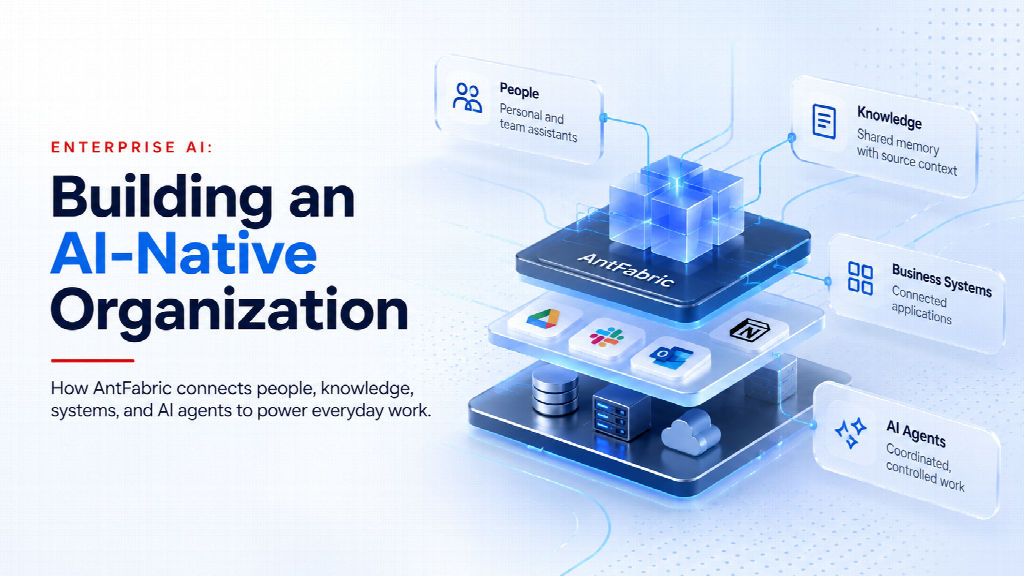

The engineering approach focuses on connecting business applications, organizational knowledge, and AI agents while maintaining defined access controls and human oversight.
SAN FRANCISCO, CA — October 29, 2026— GeekyAnts, an AI-powered digital product engineering and consulting company, has outlined the engineering approach behind AntFabric, an AI-native workplace ecosystem designed to connect enterprise applications, organizational knowledge, and AI agents within existing business environments.
The initiative addresses a growing challenge for organizations adopting artificial intelligence: integrating AI into everyday operations without creating disconnected workflows, duplicating information, or weakening established security and approval processes.
According to Gartner, 40% of enterprise applications are projected to include task-specific AI agents by the end of 2026, compared with less than 5% in 2025. As organizations explore these capabilities, the engineering decisions behind integration, permissions, and operational oversight are becoming increasingly important.
GeekyAnts’ work on AntFabric focuses on establishing a shared foundation through which AI models, connected business applications, and specialized agents can operate within defined organizational controls.
Connecting Enterprise Applications and Organizational Knowledge
Business information is frequently distributed across email platforms, meetings, project management tools, and other enterprise applications. When these systems operate independently, employees may need to transfer decisions manually, repeat data entry, or search across multiple platforms to understand the context behind a task.
AntFabric’s engineering approach addresses these challenges by connecting approved applications with AI models, organizational knowledge, and an agent runtime. The objective is to make relevant information accessible across workflows while preserving its connection to original sources and applicable access restrictions.
An AI gateway manages model access, request routing, and usage monitoring. The agent runtime coordinates activities across connected systems, while Shared Memory maintains organizational context that assistants can reference when supporting tasks or recommending actions.
For example, an assistant could identify a decision recorded during a meeting and suggest creating a corresponding project task. Another assistant could review project updates, identify an unresolved issue, and recommend a follow-up to the appropriate team member.
The architecture also accommodates personal assistants, team assistants, and specialized agents configured for different business processes. These capabilities can support workflows that require information from multiple systems without necessarily replacing the underlying applications.
GeekyAnts Chief Technology Officer Saurabh Sahu has described the company’s experience with connected workflows, stating, “Nobody here retypes the same thing into four apps any more.”
The example illustrates the operational problem that connected AI environments aim to address: reducing repetitive work while helping employees retain the context needed to make decisions.
Maintaining Access Controls and Human Oversight
Integrating AI agents with enterprise software introduces questions about data access, permissions, accountability, and the level of autonomy appropriate for different tasks.
An assistant retrieving information may need read-only access, whereas an agent modifying records, sending communications, or initiating business processes may require additional authorization. Establishing these boundaries is an important part of designing AI systems for operational use.
The architecture supporting AntFabric incorporates controls intended to align agent activities with defined responsibilities. Tool access and permissions can be restricted according to the tasks an agent is authorized to perform, while audit trails support activity tracking.
Human approval checkpoints can also be incorporated into workflows when an action requires employee review before execution.
For example, an agent could prepare an email based on meeting notes but leave the message for an employee to approve before sending. Proposed changes to sensitive business records could similarly be routed through an established approval process.
AntFabric also supports deployment approaches designed around organizational infrastructure requirements, including private cloud and on-premises environments. These options allow deployment decisions to account for existing security policies, data-handling requirements, and operational constraints.
Such considerations are relevant to organizations introducing AI into processes involving confidential information, regulated activities, or financial decisions. The engineering objective is to make automation useful within established workflows without bypassing the controls those workflows require.
A Phased Approach to Enterprise AI Implementation
Rather than attempting to automate an entire organization at once, GeekyAnts’ approach emphasizes beginning with a clearly defined business operation and expanding as requirements become clearer.
The process starts with examining how employees work, which applications they use, where information resides, and which decisions require authorization. Engineering teams can then identify the necessary integrations, establish permissions, and configure assistants or agents around the selected workflow.
A project team, for instance, could begin with an assistant that identifies pending decisions, prepares status updates, and flags activities requiring approval. After evaluating the results, the organization could introduce additional integrations or specialized agents where they offer practical value.
Starting with a limited workflow gives organizations an opportunity to evaluate usefulness, integration complexity, and governance requirements before extending AI capabilities to other departments.
It can also help engineering teams reuse architectural components across multiple workflows instead of developing every integration independently. This may simplify subsequent implementation efforts, although the results will depend on the organization’s systems, processes, and requirements.
The approach places emphasis on aligning AI implementation with actual operational needs rather than treating automation as a standalone technology project.
Applying Product Engineering to AI Integration
AntFabric forms part of GeekyAnts’ broader work in application engineering, AI integration, and systems modernization. The company’s engineering focus includes connecting existing software environments with AI capabilities and developing digital products around business requirements.
Through its AI-Powered Digital Product Engineering services, GeekyAnts works with organizations on the design, development, and modernization of software systems. Its areas of work include AI consulting, agentic AI development, enterprise applications, cloud engineering, and web and mobile product development.
The engineering considerations involved in AntFabric—including application connectivity, organizational context, permissions, and human oversight—reflect challenges that organizations may also encounter when introducing AI into their existing technology environments.
As enterprise adoption develops, decisions about integration architecture and governance will remain important to determining how AI agents fit into everyday business operations.
About GeekyAnts
GeekyAnts is an AI-powered digital product engineering and consulting company established in 2006. The company works with startups and established organizations to design, build, modernize, and scale digital products and platforms. Its services include AI consulting, agentic AI development, enterprise software engineering, cloud solutions, and web and mobile application development. GeekyAnts serves clients across industries including financial services, healthcare, retail, manufacturing, and enterprise technology, with operations in the United States, India, and the United Kingdom.
Media Contact
GeekyAnts Inc.
315 Montgomery Street, 9th and 10th Floors
San Francisco, CA 94104, USA
Phone: +1 845 534 6825
Email: info@geekyants.com
Website: https://www.geekyants.com/en-us
View the Original Press Release on SP Tech Solutions.


